
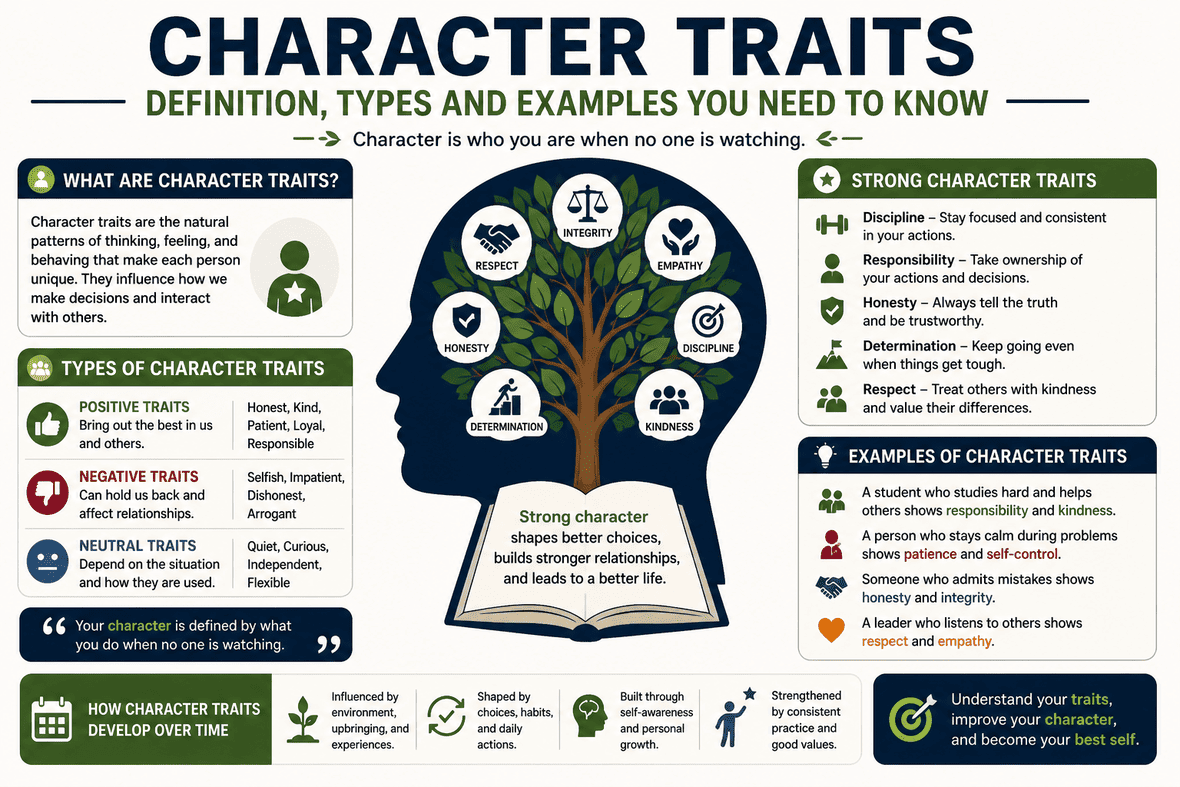
Character traits are the qualities that describe how a person usually thinks, acts, and responds to the world. They help explain someone’s behavior, choices, relationships, and attitude.
A character trait can be positive, negative, or neutral depending on how it appears. For example, a responsible person usually keeps promises and follows through. A selfish person may focus only on their own needs. A confident person may inspire others, but too much confidence can become arrogance.
This guide gives you a clear list of 50 character traits with meanings and examples. You can use it for writing, school assignments, character analysis, self-reflection, or understanding people better.
Quick Answer: What Are Character Traits?
Character traits are personal qualities that describe how someone usually behaves. They can include values, habits, emotional patterns, strengths, weaknesses, and moral qualities.
Common examples of character traits include:
- Honest
- Kind
- Brave
- Loyal
- Patient
- Responsible
- Creative
- Selfish
- Jealous
- Arrogant
Character traits are different from temporary moods. A person may feel angry for one day, but anger is not automatically a character trait. A trait is a repeated pattern that shows up over time.
What Are Character Traits?
Character traits are the inner qualities that shape a person’s actions. They often reveal what someone values, how they treat others, and how they handle problems.
For example:
- A loyal person stands by people they care about.
- A patient person stays calm when things take time.
- A dishonest person may hide the truth or mislead others.
- A courageous person acts even when something feels difficult or scary.
Character traits are useful because they help us describe people more clearly. Instead of saying “he is nice,” you can be more specific and say “he is compassionate,” “generous,” or “respectful.”
Character Traits vs Personality Traits
Character traits and personality traits are closely related, but they are not exactly the same.
Personality traits describe someone’s general style, energy, and patterns of behavior. Examples include outgoing, quiet, playful, serious, introverted, or energetic.
Character traits often focus more on values, choices, and moral behavior. Examples include honest, loyal, responsible, selfish, brave, or cruel.
A simple way to understand the difference:
- Personality traits describe how someone tends to act.
- Character traits describe the qualities behind their choices and behavior.
For example, a person can be quiet but very courageous. Another person can be outgoing but dishonest. Personality and character can overlap, but they are not identical.
50 Character Traits List With Meanings and Examples
Here is a simple reference list of 50 character traits with definitions and example sentences.
| Character Trait | Meaning | Example Sentence |
|---|---|---|
| Honest | Tells the truth and avoids misleading others | She was honest about her mistake. |
| Kind | Treats others with care and warmth | He was kind to the new student. |
| Brave | Faces fear or difficulty with courage | The brave firefighter entered the burning building. |
| Loyal | Stays faithful and supportive | A loyal friend stands by you in hard times. |
| Patient | Stays calm while waiting or dealing with problems | She was patient with her younger brother. |
| Responsible | Can be trusted to handle duties | He is responsible with his schoolwork. |
| Respectful | Treats people with dignity | The respectful student listened while others spoke. |
| Generous | Willing to give time, help, or resources | Her generous neighbor brought food for everyone. |
| Compassionate | Feels concern for others and wants to help | The nurse was compassionate with every patient. |
| Humble | Does not act superior to others | He stayed humble after winning the award. |
| Confident | Believes in their abilities | She felt confident before the presentation. |
| Creative | Uses imagination to make or solve things | His creative idea improved the project. |
| Determined | Keeps trying despite obstacles | The determined athlete trained every morning. |
| Curious | Wants to learn and understand more | A curious child asks many questions. |
| Reliable | Can be counted on | My reliable teammate always finishes the task. |
| Fair | Treats people equally and justly | The fair teacher listened to both sides. |
| Forgiving | Lets go of resentment after being hurt | He was forgiving after the argument. |
| Optimistic | Expects good things or looks for hope | Her optimistic attitude helped the group continue. |
| Disciplined | Stays focused and follows rules or routines | A disciplined student studies regularly. |
| Thoughtful | Considers other people’s feelings and needs | His thoughtful message made her feel supported. |
| Selfish | Thinks mostly about personal benefit | The selfish child refused to share. |
| Dishonest | Lies or hides the truth | A dishonest answer can damage trust. |
| Arrogant | Acts better or more important than others | His arrogant tone upset the team. |
| Lazy | Avoids effort or responsibility | The lazy worker ignored his tasks. |
| Jealous | Feels upset about another person’s success or attention | She became jealous of her friend’s award. |
| Greedy | Wants more than needed, often at others’ expense | The greedy character wanted all the treasure. |
| Cruel | Enjoys or ignores the suffering of others | The cruel villain laughed at people’s pain. |
| Impatient | Gets annoyed when things take time | He became impatient in the long line. |
| Rude | Shows poor manners or disrespect | Her rude comment hurt his feelings. |
| Stubborn | Refuses to change their mind easily | The stubborn boy would not admit he was wrong. |
| Careless | Does not pay enough attention | A careless mistake caused the problem. |
| Moody | Has frequent changes in mood | His moody behavior confused his friends. |
| Anxious | Often worried or nervous | She felt anxious before the exam. |
| Sensitive | Easily affected by feelings or criticism | A sensitive person may notice small changes in tone. |
| Calm | Stays peaceful under pressure | The calm leader helped everyone relax. |
| Ambitious | Strongly wants success or achievement | His ambitious plan required years of work. |
| Independent | Can act or think without relying too much on others | She became more independent after moving away. |
| Cooperative | Works well with others | The cooperative team finished early. |
| Adaptable | Adjusts well to change | An adaptable person can handle new situations. |
| Sincere | Says and does things honestly | His sincere apology felt genuine. |
| Caring | Shows concern for others | She is caring toward animals and people. |
| Polite | Uses good manners | The polite guest thanked the host. |
| Protective | Wants to keep others safe | The protective older sister watched over him. |
| Resourceful | Finds clever ways to solve problems | The resourceful camper fixed the tent with rope. |
| Wise | Shows good judgment and understanding | Her wise advice helped him decide. |
| Tolerant | Accepts differences in people | A tolerant person respects different opinions. |
| Pessimistic | Expects bad outcomes | His pessimistic view made the plan feel impossible. |
| Manipulative | Tries to control others unfairly | The manipulative character used guilt to get what he wanted. |
| Impulsive | Acts quickly without thinking enough | His impulsive decision caused trouble. |
| Insecure | Lacks confidence or feels unsure | She felt insecure about speaking in public. |
Positive Character Traits
Positive character traits are qualities that usually help a person build trust, make good choices, and treat others well.
Examples of positive character traits include honesty, kindness, loyalty, courage, patience, responsibility, fairness, humility, and compassion.
These traits are often valued in friendships, families, schools, workplaces, and stories because they show strength of character.
Honesty
Honesty means telling the truth and avoiding deception. An honest person does not hide facts to protect their image or gain an unfair advantage.
Example:
“She was honest about losing the book and offered to replace it.”
Kindness
Kindness means treating others with warmth, care, and respect. A kind person may help without expecting anything in return.
Example:
“He showed kindness by helping his classmate carry the heavy box.”
Responsibility
Responsibility means being dependable and taking ownership of your actions. A responsible person follows through on duties and admits mistakes.
Example:
“She was responsible enough to finish the project before the deadline.”
Courage
Courage means doing what is right or necessary even when it feels difficult. Courage does not mean having no fear. It means acting despite fear.
Example:
“He showed courage by speaking up when someone was being treated unfairly.”
Patience
Patience means staying calm when something takes time or becomes frustrating. Patient people can handle delays without reacting harshly.
Example:
“The teacher was patient while the students learned a difficult topic.”
Negative Character Traits
Negative character traits are qualities that can harm relationships, reduce trust, or create problems when they become repeated patterns.
Examples of negative character traits include dishonesty, selfishness, arrogance, cruelty, jealousy, greed, laziness, and manipulation.
A negative trait does not mean a person is bad forever. People can grow, change, and develop better habits. But identifying negative traits can help explain conflict in real life or in stories.
Dishonesty
Dishonesty means lying, hiding the truth, or misleading others. It often damages trust.
Example:
“His dishonesty made it hard for his friends to believe him later.”
Selfishness
Selfishness means caring mostly about your own wants, even when others are affected.
Example:
“She acted selfishly when she took the last piece without asking.”
Arrogance
Arrogance means acting superior to others. An arrogant person may ignore advice, dismiss people, or exaggerate their importance.
Example:
“His arrogance made the group less willing to work with him.”
Laziness
Laziness means avoiding effort or responsibility. It becomes a problem when someone refuses to contribute or improve.
Example:
“The lazy character expected others to do all the work.”
Jealousy
Jealousy means feeling upset or threatened by someone else’s success, attention, or relationships.
Example:
“He felt jealous when his friend received praise.”
Neutral or Context-Based Character Traits
Some character traits are not always positive or negative. Their meaning depends on the situation.
For example, being stubborn can be negative when someone refuses to listen. But it can look like determination when someone keeps going for a good reason.
Being sensitive can make someone easily hurt, but it can also make them thoughtful and emotionally aware.
Examples of context-based traits include:
- Quiet
- Serious
- Sensitive
- Stubborn
- Ambitious
- Cautious
- Competitive
- Independent
- Emotional
- Reserved
These traits need context before you label them as strengths or weaknesses.
Emotional Character Traits
Emotional character traits describe how a person usually handles feelings. These traits often affect relationships and decision-making.
Examples include:
- Calm
- Anxious
- Sensitive
- Moody
- Patient
- Impulsive
- Compassionate
- Forgiving
- Pessimistic
- Optimistic
For example, a calm person may stay steady during conflict. An impulsive person may react quickly before thinking. A compassionate person may notice when others are hurting.
Emotional traits are especially useful when analyzing fictional characters because they explain how a character responds to pressure, fear, loss, success, or conflict.
Character Traits in Literature and Writing
Character traits are important in stories because they help readers understand why a character behaves a certain way.
A strong character is not defined by one trait only. Most realistic characters have a mix of strengths, flaws, fears, and motivations.
For example:
- A brave character may also be impatient.
- A kind character may struggle with insecurity.
- A loyal character may become stubborn.
- A confident character may become arrogant.
Writers use traits to build character development. When a character changes over time, that change is often connected to their traits.
For example, a selfish character may learn generosity. A fearful character may develop courage. A dishonest character may learn the value of truth.
Character Traits for Students
Students often use character traits when describing people in books, history, or real life.
When choosing a trait, look for evidence. Do not only name the trait. Explain the action that proves it.
Weak answer:
“The character is brave.”
Stronger answer:
“The character is brave because she protects her younger brother even though she is afraid.”
This makes the answer clearer and more convincing.
Useful traits for school assignments include:
- Honest
- Brave
- Kind
- Loyal
- Responsible
- Selfish
- Jealous
- Curious
- Determined
- Respectful
- Arrogant
- Patient
- Creative
- Caring
- Fair
How to Identify Character Traits
To identify a character trait, look at repeated behavior. One action may not be enough. A trait usually appears more than once.
Ask these questions:
- How does the person treat others?
- What do they do when they face a problem?
- Do they keep promises?
- How do they react to criticism?
- What choices do they make when no one is watching?
- Do their actions match their words?
- How do other people respond to them?
A character trait should be supported by evidence.
For example, if a character shares food, comforts a friend, and helps someone in need, you could describe them as kind, generous, or compassionate.
Character Traits Example Sentences
Here are simple sentences that show how to use character traits correctly.
- She is honest because she tells the truth even when it is difficult.
- He is loyal because he supports his friends during hard times.
- The character is selfish because he only thinks about his own comfort.
- Maria is patient when she teaches her younger sister.
- The villain is cruel because he enjoys hurting others.
- Daniel is responsible because he finishes his work without being reminded.
- The leader is confident, but not arrogant.
- She is compassionate because she cares about people who are suffering.
- He is impulsive because he acts before thinking.
- The main character becomes more courageous by the end of the story.
Positive vs Negative Character Traits Table
| Positive Trait | Opposite Negative Trait | Simple Difference |
|---|---|---|
| Honest | Dishonest | Truthful vs misleading |
| Kind | Cruel | Caring vs harmful |
| Humble | Arrogant | Modest vs superior |
| Generous | Greedy | Giving vs always wanting more |
| Patient | Impatient | Calm waiting vs easily frustrated |
| Responsible | Careless | Dependable vs inattentive |
| Loyal | Disloyal | Faithful vs unreliable |
| Respectful | Rude | Considerate vs disrespectful |
| Courageous | Cowardly | Acts despite fear vs avoids fear |
| Fair | Unfair | Just vs biased |
How to Use This Character Traits List
You can use this list in different ways:
- For school character analysis
- For writing fictional characters
- For building a character sketch
- For understanding personality and behavior
- For comparing positive and negative traits
- For self-reflection
- For classroom vocabulary practice
- For describing people more clearly
Instead of memorizing every trait, focus on choosing the most accurate word for the situation.
For example, “nice” is general. “Generous,” “thoughtful,” “compassionate,” and “respectful” are more specific.
Specific traits make your writing clearer and more useful.
Frequently Asked Questions About Character Traits
What are character traits?
Character traits are qualities that describe how a person usually thinks, behaves, and treats others. Examples include honesty, kindness, courage, patience, selfishness, and arrogance.
What are 5 examples of character traits?
Five common examples of character traits are honest, kind, brave, loyal, and responsible. These traits describe repeated patterns in a person’s behavior.
What are positive character traits?
Positive character traits are qualities that usually help people build trust and healthy relationships. Examples include honesty, empathy, patience, fairness, courage, humility, and responsibility.
What are negative character traits?
Negative character traits are qualities that can harm trust, relationships, or decision-making. Examples include dishonesty, selfishness, arrogance, cruelty, greed, and jealousy.
Are character traits and personality traits the same?
They are related, but not exactly the same. Personality traits describe someone’s general style or behavior, while character traits often describe values, choices, and moral qualities.
How do you identify a character trait?
Look at repeated actions, choices, words, and reactions. A character trait should be supported by evidence. For example, if someone keeps promises and finishes tasks, they may be responsible.
Is confidence a character trait?
Yes, confidence can be a character trait when it appears as a repeated pattern. A confident person believes in their abilities, but too much confidence may become arrogance.
Can character traits change?
Yes. People can develop new habits, learn from mistakes, and strengthen positive traits over time. Traits are patterns, but they are not always permanent.
Why are character traits important?
Character traits help explain behavior. They are useful for understanding people, writing characters, analyzing stories, and describing strengths and weaknesses clearly.
What is the difference between a trait and a mood?
A mood is temporary, but a trait is a repeated pattern. For example, feeling angry one day is a mood. Being consistently impatient or hostile may be a trait.