
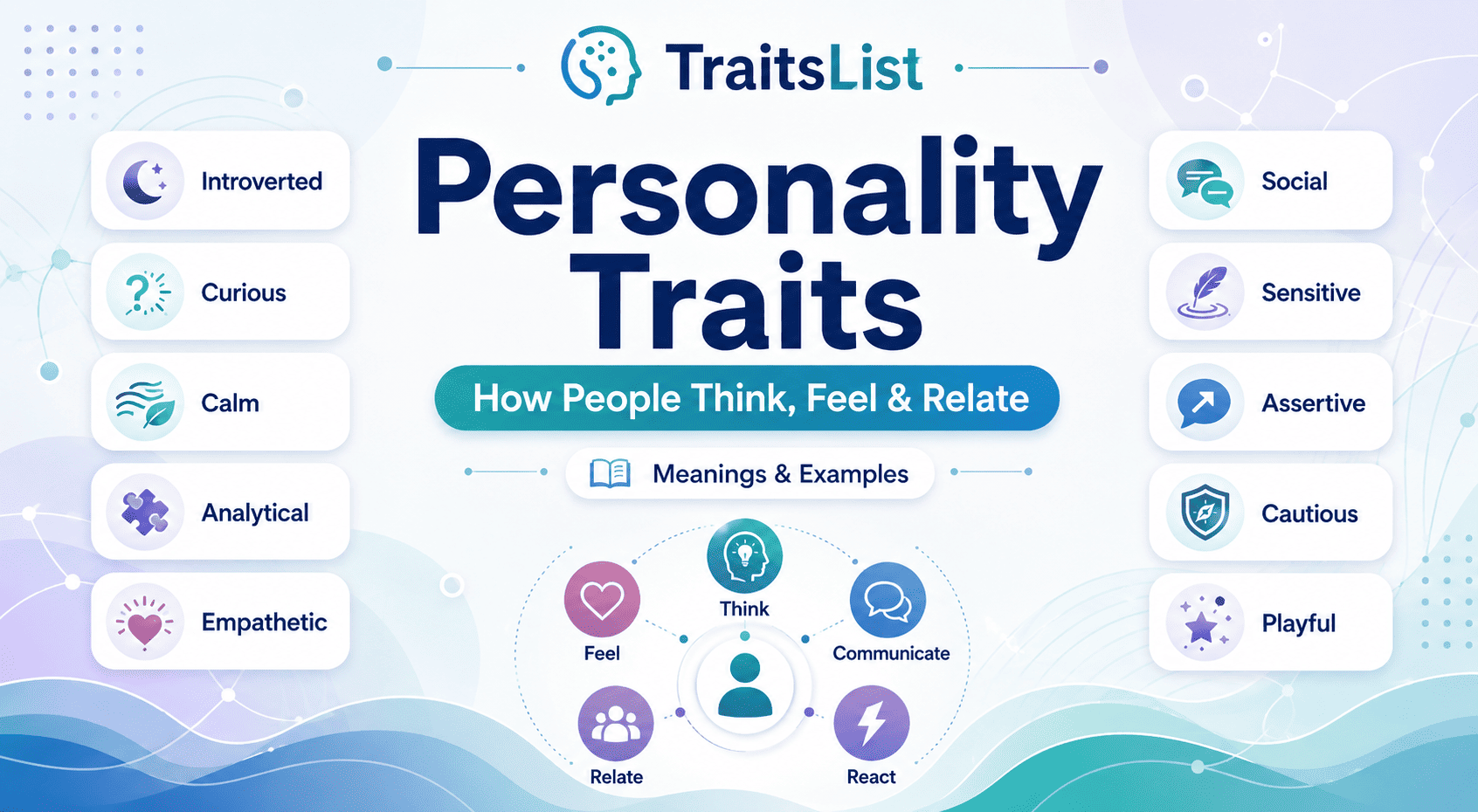
Personality traits describe the usual patterns in how a person thinks, feels, communicates, reacts, and relates to others.
Some people are naturally calm. Some are expressive. Some are cautious, curious, intense, playful, private, organized, sensitive, or outgoing. These patterns help explain a person’s social style, emotional style, and everyday behavior.
This page is a reference guide to personality traits. You can use it to describe yourself, understand other people, write better characters, or build a clearer vocabulary for human behavior.
Quick Answer: What Are Personality Traits?
Personality traits are stable patterns in how a person usually thinks, feels, reacts, communicates, and relates to others.
Examples of personality traits include introverted, outgoing, curious, calm, sensitive, assertive, cautious, organized, playful, analytical, spontaneous, and empathetic.
Personality traits are not exactly the same as character traits. Character traits often describe values and moral qualities, such as honesty, loyalty, courage, fairness, or selfishness. Personality traits describe temperament, emotional style, thinking style, and social behavior.
What Are Personality Traits?
Personality traits are the qualities that shape someone’s natural way of being.
They can affect:
- how a person thinks
- how they handle emotions
- how they communicate
- how they respond to stress
- how they behave in groups
- how they make decisions
- how they form relationships
- how they approach change
For example, an analytical person may prefer logic and evidence. A warm person may connect easily with others. A cautious person may think carefully before acting. A spontaneous person may enjoy quick decisions and new experiences.
A personality trait is not just one action. It is a pattern that appears again and again.
Personality Traits vs Character Traits
Personality traits and character traits are related, but they are not the same.
Personality traits describe someone’s natural style.
Character traits often describe someone’s values, choices, and moral behavior.
A simple way to separate them:
| Trait Type | What It Describes | Examples |
|---|---|---|
| Personality traits | How someone usually thinks, feels, reacts, and relates to others | Introverted, outgoing, sensitive, calm, curious, assertive |
| Character traits | Values, morals, strengths, flaws, and choices | Honest, loyal, fair, brave, selfish, cruel |
For example, a person can be quiet and honest. Quiet is a personality trait. Honest is more of a character trait.
A person can also be outgoing and dishonest. Outgoing describes social style. Dishonest describes behavior and moral choice.
This page focuses on personality, temperament, emotional style, thinking style, communication style, and social behavior.
Personality Traits List With Meanings and Examples
Here is a practical list of personality traits with simple meanings and example sentences.
| Personality Trait | Meaning | Example Sentence |
|---|---|---|
| Introverted | Prefers quiet, depth, or smaller social settings | She is introverted and enjoys one-on-one conversations. |
| Extroverted | Gains energy from social interaction | He is extroverted and enjoys meeting new people. |
| Curious | Wants to learn, explore, and ask questions | A curious person wants to understand how things work. |
| Calm | Stays steady and peaceful under pressure | She stayed calm during the stressful meeting. |
| Sensitive | Feels emotions deeply or notices subtle changes | He is sensitive to criticism and tone of voice. |
| Analytical | Thinks carefully and logically | Her analytical mind helped solve the problem. |
| Creative | Uses imagination and original ideas | He has a creative way of explaining difficult topics. |
| Organized | Likes structure, order, and planning | An organized person keeps tasks and schedules clear. |
| Spontaneous | Acts naturally without too much planning | She is spontaneous and enjoys last-minute trips. |
| Cautious | Thinks carefully before taking risks | He is cautious before making big decisions. |
| Assertive | Expresses needs and opinions clearly | She was assertive without being rude. |
| Reserved | Keeps thoughts or feelings private | He seems reserved around people he does not know well. |
| Talkative | Enjoys speaking and sharing thoughts | The talkative student joined every discussion. |
| Reflective | Thinks deeply about experiences and ideas | A reflective person learns from past choices. |
| Practical | Focuses on useful, realistic solutions | She has a practical approach to everyday problems. |
| Optimistic | Tends to expect positive outcomes | His optimistic view helped the team stay motivated. |
| Pessimistic | Tends to expect problems or negative outcomes | A pessimistic person may notice risks quickly. |
| Flexible | Adapts well when plans change | She is flexible when schedules shift. |
| Stubborn | Finds it hard to change opinions or plans | He can be stubborn when he believes he is right. |
| Empathetic | Understands or feels what others may feel | An empathetic friend listens with care. |
| Independent | Prefers making decisions without much help | She is independent and likes solving problems alone. |
| Dependent | Often seeks support, guidance, or reassurance | He becomes dependent when he feels unsure. |
| Competitive | Wants to perform better or win | Her competitive side appears during games. |
| Cooperative | Works well with others | A cooperative teammate listens and contributes. |
| Playful | Enjoys humor, fun, and lightness | His playful personality makes people laugh. |
| Serious | Focuses on responsibility, depth, or importance | She has a serious attitude during important work. |
| Patient | Handles delays or frustration calmly | He is patient when teaching beginners. |
| Impatient | Gets frustrated when things take too long | She becomes impatient in slow conversations. |
| Warm | Friendly and emotionally open | His warm personality makes people feel welcome. |
| Distant | Emotionally reserved or hard to connect with | She may seem distant when she is tired. |
| Confident | Trusts their ability or judgment | He sounded confident during the presentation. |
| Insecure | Often feels unsure or not good enough | An insecure person may need frequent reassurance. |
| Adaptable | Adjusts easily to new situations | She is adaptable in changing environments. |
| Methodical | Does things in a careful, step-by-step way | His methodical style prevents mistakes. |
| Intuitive | Understands things through instinct or feeling | She made an intuitive decision quickly. |
| Logical | Uses reason and clear thinking | A logical person looks for evidence before deciding. |
| Emotional | Expresses or feels emotions strongly | He has an emotional reaction to meaningful stories. |
| Easygoing | Relaxed and not easily upset | Her easygoing nature helps reduce tension. |
| Intense | Feels or expresses things strongly | He brings intense focus to every project. |
| Diplomatic | Communicates carefully to avoid conflict | She gave diplomatic feedback during the meeting. |
| Direct | Speaks clearly and plainly | His direct communication style is easy to understand. |
| Private | Does not share personal details easily | She is private about her personal life. |
| Open | Willing to share thoughts and feelings | He is open about what he needs. |
| Ambitious | Strongly motivated to grow or achieve | Her ambitious personality pushes her forward. |
| Modest | Does not draw too much attention to achievements | He is modest even when he succeeds. |
| Adventurous | Enjoys new experiences and uncertainty | An adventurous person likes trying unfamiliar things. |
| Careful | Pays attention to details and possible mistakes | She is careful with important documents. |
| Energetic | Has active, lively energy | His energetic style motivates the group. |
| Quiet | Speaks less or prefers calm environments | A quiet person may still be very observant. |
| Social | Enjoys interacting with people | She is social and likes group activities. |
Thinking Style Traits
Thinking style traits describe how a person processes information, solves problems, and makes sense of the world.
Examples include:
- analytical
- creative
- logical
- intuitive
- reflective
- practical
- curious
- imaginative
- detail-oriented
- open-minded
An analytical person may break problems into smaller parts. A creative person may look for unusual ideas. A reflective person may need time to think before responding.
These traits are useful when describing how someone learns, works, plans, or makes decisions.
Emotional Style Traits
Emotional style traits describe how a person experiences and expresses feelings.
Examples include:
- calm
- sensitive
- emotional
- intense
- patient
- impatient
- optimistic
- pessimistic
- insecure
- steady
A calm person may stay balanced during pressure. A sensitive person may notice emotional details that others miss. An intense person may feel things deeply and express them strongly.
Emotional traits are not automatically good or bad. They often become strengths or challenges depending on the situation.
Social Style Traits
Social style traits describe how someone behaves around other people.
Examples include:
- introverted
- extroverted
- reserved
- social
- warm
- distant
- cooperative
- independent
- talkative
- private
An introverted person may prefer fewer, deeper conversations. An extroverted person may enjoy group energy. A warm person may make others feel comfortable quickly.
These traits help explain how people connect, build relationships, and behave in groups.
Communication Style Traits
Communication style traits describe how someone shares thoughts, opinions, feelings, and needs.
Examples include:
- direct
- diplomatic
- assertive
- quiet
- expressive
- reserved
- open
- careful
- talkative
- thoughtful
A direct person says things clearly. A diplomatic person chooses words carefully. An assertive person can express opinions without attacking others.
Communication traits are important in relationships, school, work, leadership, and conflict.
Reaction Style Traits
Reaction style traits describe how a person responds to change, stress, criticism, pressure, or surprise.
Examples include:
- adaptable
- cautious
- impulsive
- calm
- defensive
- flexible
- stubborn
- anxious
- resilient
- reactive
A cautious person may pause before acting. A flexible person adjusts when plans change. An impulsive person may react quickly before thinking everything through.
Reaction style often shows up most clearly when life becomes stressful.
Positive Personality Traits
Positive personality traits usually help people connect with others, handle situations well, and build healthy patterns.
Examples include:
- warm
- empathetic
- calm
- flexible
- open-minded
- thoughtful
- confident
- cooperative
- adaptable
- patient
- curious
- balanced
- sincere
- encouraging
- dependable
These traits can support friendships, teamwork, leadership, learning, and emotional maturity.
Example:
A person who is calm, empathetic, and direct may handle conflict in a healthy way. They can listen, speak clearly, and avoid making the situation worse.
Neutral Personality Traits
Some personality traits are not clearly positive or negative. They depend on context.
Examples include:
- quiet
- serious
- competitive
- private
- cautious
- intense
- independent
- reserved
- emotional
- spontaneous
- skeptical
- ambitious
For example, being quiet can mean someone is thoughtful and observant. But in another situation, it may make communication harder.
Being competitive can motivate achievement. But if it becomes too strong, it may create tension.
Neutral traits need context before they are judged.
Challenging Personality Traits
Challenging personality traits can make relationships, communication, or decision-making harder when they become too strong.
Examples include:
- impatient
- defensive
- insecure
- controlling
- overly critical
- impulsive
- rigid
- distant
- pessimistic
- reactive
- stubborn
- suspicious
These traits do not make someone a bad person. They describe patterns that may create difficulty.
For example, a defensive person may struggle to accept feedback. A rigid person may find change stressful. An impulsive person may act before thinking through consequences.
The goal is not to label people harshly. The goal is to describe patterns more clearly.
Big Five Personality Traits Explained Simply
The Big Five is a common way to describe broad personality patterns. It groups personality into five major areas:
- openness
- conscientiousness
- extraversion
- agreeableness
- neuroticism
These are broad categories, not fixed personality types.
Openness
Openness describes curiosity, imagination, and willingness to explore new ideas.
A person high in openness may be creative, curious, imaginative, and interested in new experiences.
A person lower in openness may prefer routine, familiarity, and practical solutions.
Conscientiousness
Conscientiousness describes organization, responsibility, planning, and self-discipline.
A person high in conscientiousness may be organized, reliable, careful, and goal-focused.
A person lower in conscientiousness may be more spontaneous, flexible, or less structured.
Extraversion
Extraversion describes social energy and outward expression.
A person high in extraversion may be outgoing, talkative, energetic, and socially active.
A person lower in extraversion may be introverted, quiet, private, or more comfortable in smaller settings.
Agreeableness
Agreeableness describes cooperation, empathy, kindness, and concern for others.
A person high in agreeableness may be warm, supportive, forgiving, and cooperative.
A person lower in agreeableness may be more skeptical, competitive, direct, or independent.
Neuroticism
Neuroticism describes emotional sensitivity and tendency toward stress, worry, or emotional reactivity.
A person high in neuroticism may feel emotions strongly, worry more easily, or react intensely to stress.
A person lower in neuroticism may be calmer, steadier, and less emotionally reactive.
Personality Traits in Relationships
Personality traits affect how people connect with others.
In relationships, useful traits may include:
- empathy
- warmth
- patience
- openness
- emotional awareness
- flexibility
- direct communication
- trust
- calmness
- cooperation
Challenging traits may include:
- defensiveness
- jealousy
- emotional distance
- impulsiveness
- avoidance
- control
- insecurity
- poor communication
For example, a private person may need more personal space. A talkative person may process feelings through conversation. A sensitive person may need gentle communication. A direct person may value clear answers.
Understanding personality traits can make relationships easier because it helps people see patterns instead of only reacting to behavior.
Personality Traits at Work and School
Personality traits also affect learning, teamwork, leadership, and productivity.
Helpful traits at work or school may include:
- organized
- focused
- cooperative
- curious
- adaptable
- confident
- practical
- analytical
- patient
- responsible
Different environments value different traits.
A creative person may be strong at brainstorming. An analytical person may be strong at problem-solving. A social person may be good at teamwork. A careful person may catch mistakes others miss.
No single personality style is best for every situation.
How to Identify Personality Traits
To identify a personality trait, look for repeated patterns.
Ask:
- How does this person usually think?
- How do they respond to stress?
- Are they more private or open?
- Are they more cautious or spontaneous?
- Do they prefer groups or one-on-one settings?
- How do they communicate?
- How do they handle emotions?
- What behaviors appear again and again?
One moment is not enough to define a trait.
For example, someone may be quiet in one meeting because they are tired. But if they usually prefer calm environments and smaller conversations, introverted may be a more accurate trait.
Personality Traits Example Sentences
Here are simple example sentences using personality traits correctly.
- She is introverted and prefers quiet conversations.
- He is extroverted and enjoys meeting new people.
- Maria is analytical when solving problems.
- Daniel is creative and often finds original ideas.
- She is sensitive to tone and body language.
- He is calm during stressful situations.
- My friend is spontaneous and enjoys sudden plans.
- The manager is direct but respectful.
- She is diplomatic when handling conflict.
- He is cautious before making important decisions.
- A warm person makes others feel welcome.
- An insecure person may need extra reassurance.
- A flexible person adapts when plans change.
- A serious person may focus deeply on responsibilities.
- An optimistic person looks for hope in difficult moments.
How to Use This Personality Traits List
You can use this list to:
- describe yourself more clearly
- understand other people’s behavior
- write realistic fictional characters
- compare different communication styles
- describe emotional patterns
- understand relationship dynamics
- build vocabulary for school or writing
- reflect on strengths and challenges
Try to choose specific words.
Instead of saying “nice,” you might say warm, empathetic, gentle, friendly, or supportive.
Instead of saying “hard to deal with,” you might say defensive, impatient, rigid, distant, or reactive.
Specific trait words make descriptions clearer and more useful.
Frequently Asked Questions About Personality Traits
What are personality traits?
Personality traits are the usual patterns in how a person thinks, feels, reacts, communicates, and relates to others. Examples include introverted, outgoing, calm, sensitive, curious, organized, assertive, and cautious.
What are 5 examples of personality traits?
Five common personality traits are introverted, extroverted, curious, calm, and organized. These traits describe a person’s usual style of thinking, feeling, and behaving.
What are 50 personality traits?
A list of 50 personality traits can include introverted, extroverted, curious, calm, sensitive, analytical, creative, organized, spontaneous, cautious, assertive, reserved, talkative, reflective, practical, optimistic, pessimistic, flexible, stubborn, empathetic, independent, competitive, cooperative, playful, serious, patient, impatient, warm, distant, confident, insecure, adaptable, methodical, intuitive, logical, emotional, easygoing, intense, diplomatic, direct, private, open, ambitious, modest, adventurous, careful, energetic, quiet, social, and thoughtful.
What is the difference between personality traits and character traits?
Personality traits describe how someone usually thinks, feels, communicates, reacts, and relates to others. Character traits often describe values, morals, choices, strengths, and flaws, such as honesty, loyalty, courage, fairness, or selfishness.
Are personality traits genetic?
Personality traits can be influenced by both genetics and life experience. A person may have natural tendencies, but environment, relationships, habits, and personal growth can also shape personality over time.
Can personality traits change?
Yes, personality traits can change gradually. People often become more self-aware, emotionally mature, confident, organized, or flexible through experience, practice, and life changes.
What are positive personality traits?
Positive personality traits are patterns that usually help people relate well to others and handle life effectively. Examples include empathy, calmness, flexibility, confidence, patience, curiosity, warmth, and open-mindedness.
What are negative personality traits?
Some personality traits can become challenging when they are too strong or poorly managed. Examples include defensiveness, impatience, insecurity, rigidity, impulsiveness, emotional distance, and pessimism.
What are the Big Five personality traits?
The Big Five personality traits are openness, conscientiousness, extraversion, agreeableness, and neuroticism. They are broad categories used to describe common personality patterns.
Which personality type am I?
A single page cannot accurately tell you your full personality type. To understand your personality, look at repeated patterns in how you think, feel, communicate, react, and relate to others. Personality tests can help, but they should be used as reflection tools, not fixed labels.